From a kind neighbor, I got a block of aluminum and hacksawed out a roughly 1" x 1" x 2" block. Not having a lathe, I drilled the central hole and modified a bolt so that I could chuck it up in my 50s-era Delta drill press inherited from my Father.
Thursday, March 10, 2022
A Bar-End Mirror Mount
From a kind neighbor, I got a block of aluminum and hacksawed out a roughly 1" x 1" x 2" block. Not having a lathe, I drilled the central hole and modified a bolt so that I could chuck it up in my 50s-era Delta drill press inherited from my Father.
Wednesday, December 30, 2020
Adding CAT to the QCX
I enjoy QRP CW and prefer the N1MM Logger+ while contesting . When Hans Summer (G0UPL) added the potential for computer communications to the firmware for his QRPLabs QCX models, I was very interested.
Hans' latest incarnation of the QCX-style rig is the QCX+. The QCX+ has the hardware for computer communications built in, but the older QCX does not.
You will need at least firmware version 1.03 (the latest version would be best), along with two resistors, a diode and a way to get the TTL data in and out . For the connection to your PC, you will need a TTL to USB converter. The later was the biggest expense by far.
Below (mostly in pictures) is how I added the necessary hardware. Notes and an example N1MM Contest Logger function key file follow.
If you click on the images they will enlarge:
I got my parts from Mouser for about $10 plus shipping (I had four QCX transceivers to convert). The TTL to USB cable was from Amazon for about $14 - but you only need one of those! The 'DTEK DT-6562 USB TTL to 3.5mm audio jack serial cable' worked for me. Be careful - there are non-working imitations out there...
I used very small stranded cable from the junkbox - and the colors helped me keep up with the leads after the shrink tubing was applied..
It is a tight squeeze to get the 3.5mm jack into position (and you may have to bend the shell, tip and ring connections to avoid the CW straight key), but the jack from Mouser conveniently nestles into the cutout on the BaMaTech case which gives you a little more room.
Hans wrote notes on this mod that I would strongly urge you to read. They are in the assembly manuals for the later models on this page and again, I would encourage you to check them out before attempting this mod.
I primarily use N1MM+ for contesting and I use the "CATA1ASC KY" commands to communicate with the QCX directly - no additional electronics other than the TTL to USB cable are needed. Below is a function key file I use for the weekly CWTs sponsored by CWOPS that you might use as a model (after editing, of course).
#REM cwt.MC
#REM 12-30-2020 wb5bkl
F1 CQ cwt, {CATA1ASC KY cq cwt * * k;}
F2 Exch, {CATA1ASC KY ! {EXCH} ;}
F3 Tu, {CATA1ASC KY tu ;}
F4 {MYCALL}, {CATA1ASC KY * ;}
F5 His Call?, {CATA1ASC KY ! ? ;}
F6 DUPE, {CATA1ASC KY B4 e~e ;}
F7 QRZ?, {CATA1ASC KY QRZ? ;}
F8 Agn?, {CATA1ASC KY agn? ;}
F9 Name?, {CATA1ASC KY name? ;}
F10 Nr?, {CATA1ASC KY nr? ;}
F11 Spcl, {CATA1ASC KY HNY e~e ;}
F12 Wipe, {WIPE}
#S&P ----------- Search and Pounce Messages begin here -----
F1 QRL?, {CATA1ASC KY qrl? {MYCALL} ;}
F2 Exch, {CATA1ASC KY {EXCH} ;}
F3 Tu, {CATA1ASC KY tu ;}
F4 {MYCALL}, {CATA1ASC KY * ;}
F5 His Call?, {CATA1ASC KY !? ;}
F6 1371, {CATA1ASC KY 1371 ;}
F7 NICK, {CATA1ASC KY nick ;}
F8 Agn?, {CATA1ASC KY agn? ;}
F9 Nr?, {CATA1ASC KY nr? ;}
F10 Nme?, {CATA1ASC KY name? ;}
F11 Spcl, {CATA1ASC KY HNY e~e ;}
F12 Wipe, {WIPE}
#REM ----------, Special instructions begin at end-of-file -
#REM, S&P F1 calls QRL? before placing the program in RUN mode
#REM, Designed to work in either ESM or non-ESM mode
#REM, F5 uses "!" macro for his callsign
#REM,
73 and good luck!
cln - Nick
WB5BKL
Sunday, October 25, 2020
K75 - Cleaning the Fuel Injectors -
Recently fuel tank contamination apparently did a number on the fuel pump and filter on my 1994 K75. After cleaning the tank, I found, as expected, the fuel injectors were apparently blocked and not working.
A search for help from local repair shops yielded nothing. Sending them off to a BMW shop would be about $50 a pop - plus postage.I elected to try to clean them myself.
I wish I could tell you I came up with this, but I did not. Here is a link to the video where I got the idea. He is working on injectors from a modern BMW R-bike. His cleaner appears at about 7:30 into the video.
And to the right is my interpretation of the same cleaner.
The switch is a micro switch from the junk box. I did not have the proper connector so I had to adapt some female connectors from a plug - also from the junk box. The syringe I found for $1 in the veterinary department of our local feed store (click on the images to make them larger). I did replace all the O-rings (FEL-PRO ES 70599 - at the local auto parts store) - about $8 for two packages of 4.


The cleaner proved very successful.
I used ethanol (denatured alcohol) first, then B-12 Chemtool. I think the ethanol did the most good for the contamination I had.
Re-fitted the injectors to the rail (which I also cleaned), buttoned everything up and the K75 started up after about 3 seconds of cranking.
Very pleased. My sincere thanks to Doug Rost.
cln
Tuesday, September 22, 2020
CWOPs in the Texas QSO Party
The TQP is my favorite 'big' contest each year. While doing my usual CW-QRP thing this month, I kept noticing that during a lot of QSOs, a name would pop into my head though not part of the exchange: Sam, Van, Marv, Chuck, Hank, John (lots of those), Claude and so on. I realized that they were familiar from the CWTs that I enjoy on Wednesdays. There were so many that I became curious about how many CWOPs I was working.
At first I thought it would take a little programing to answer the question but, at least in Linux, it was actually pretty easy.First I went to the CWOPs website, found the member roster and downloaded a spreadsheet file with all the member calls listed. From that spreadsheet I copied only the calls (well over 2000 currently) to a file: CWOPs_members.txt - one call per line
Then I used a similar process on my TQP log but removed the dupes (for example I worked VE3NNT on 2 bands) before copying that data to another file: TQP_2020_uniques.txt - again one call per line
I used the Linux command grep to look at leach line in the first file and check for a match in the second file with output to Matches.txt:
grep -oFf CWOPs_members.txt TQP_2020_uniques.txt > Matches.txt
If I had only wanted a count, I could have used:
grep -oFf CWOPs_members.txt TQP_2020_uniques.txt | wc -l
I found that slightly over 46% of the contacts I made in the TQP were with CWOPs members. More than I thought. Almost half.
My thanks to each and every one of them.
Thursday, August 6, 2020
An Omni-Angle Antenna for 6M
Thursday, June 20, 2019
Popsicle or Ice Lolly QCX Stand
Construction images - not much to it. Comments below. Click on the images to enlarge them for details and to make my mistakes easier to see:
Note that the 'kick stand' skewer rotates in the bottom sticks. The support skewers bear on the four QCX feet.
If I had it to do over, I would have made it wider and had the 'kick stand' to rotate within the lower Popsicle (ice lolly) sticks - that way it would fold flat for storage. :-) Oh well.
Well under an hour, excluding the gluing time.
cln - Nick
WB5BKL
Lake Buchanan
Wednesday, February 13, 2019
160M 1:2.25 Impedance Transformer
At this writing, I have 12 radials at the base, with various lengths of 15 to 40 feet over very rocky soil (granite, gneiss).
I did no modeling - just threw up some wire that fit my physical situation. Impedance at resonance was around 24 Ohms.
I wound a test transformer on an old toroid of unknown characteristics just to see if I could get close to a 50 Ohms match. That was successful and I even made several contacts at QRP levels.
I decided to wind a better (and I hope, more efficient) version. I used a FT-150A-K core from Amidon along with 10 feet of AWG#14 HAPT wire and some glass cloth tape. The transformer I chose was the W2FMI-2.25:1-HU50 from the Amidon Transmission Line Transformers Handbook on the Amidon website. this is a Jerry Sevick design. I am, of course, using it 'backwards'...
To the right is the toroid as wound. Sevick notes that the #14 takes some effort to wind and suggests leaving long leads on each end for leverage. Good advice.The image below shows (unclearly - sorry) the connections before soldering.
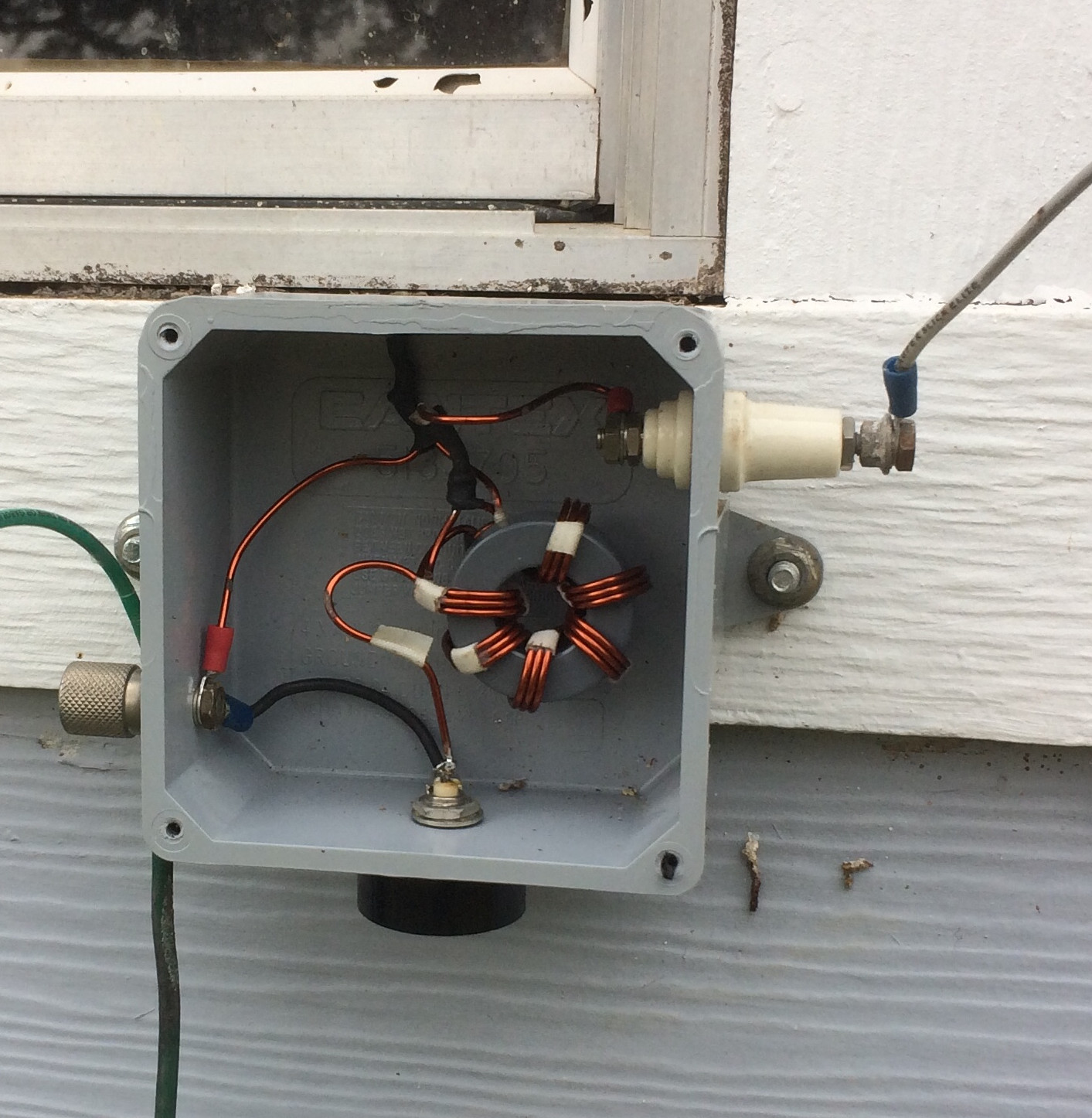
And here is the wired version with the "proof of concept " un-un to the left. The box is an outdoor junction box (with water-sealed lid, not shown) that I picked up at a local big-box store. Pretty handy.
And here it is as installed. The BNC feed to the shack is at the bottom, the inverted "L" connects to the right and the ground and radials to the left.
So far, I am very pleased to get something cheap and easy working for 160M. This might not be the best antenna, but for my circumstance it is up and working. At 1810KHz, the antenna presents a SWR of about 1:1.1, rising quickly away from that QRP frequency.
I do appreciate Mr. Sevick's work.
Now for more radials!
cln - Nick
WB5BKL
Lake Buchanan
Sunday, November 25, 2018
A Grand Day Out - QRP Portable
I was able to operate portable four times this year. Briefly, here are some photos and comments.
Texas State Parks on the Air (TSPOTA)

I operated only on Saturday - April 7th. As it was cool (~39F), damp and threatening rain, I elected to operate while sitting in the car at Longhorn Cavern State Park (EM00tq). I only made 15 QSOs No other Texas state parks were heard. As of this writing, no scores have been posted. Used the K1 @ 5W with a 20M dipole. This is a pleasant and scenic location, and my closest state park.QRP to the Field (QRPTTF)
Two weeks after the TSPOTA event, I was out again - this time at Black Rock Park in Llano County (EM00ss). More on Black Rock Park later. Rig was again the K1 and this time I hung a 40M EFHW in addition to the 20M dipole. 25 QSOs was good enough to get me into the top five.. Got to meet a dog named Gussie. She was interested in my stash of Ritz crackers.
The Flight of the Bumblebees (FotBBs)
This was on the 29th of July and again at Black Rock Park. I made 29 QSOs and had another good time. It was very warm and lots of folks were enjoying the park. Same rig as above.
The Skeeter Hunt
This was on the 29th of August and once more at Black Rock Park. Again 29 QSOs with the K1 @ 5W, the 20M dipole and the 40M EFHW.
More on Black Rock Park
This park, on the west side of Lake Buchanan, is operated by the Lower Colorado River Authority (LCRA). This is not a state park, but is operated in a similar manner. In my experience, these parks are very popular with families, especially in the summertime. I would strongly suggest reservations or getting there early and being flexible. Here are some links:
LCRA
Black Rock Park
I had a very good experience at this park. The staff was both friendly and very helpful. I did a scouting run through the park early in 2018 and made note of the sites with 20 and 40M spaced trees. :-) No one seemed to have any problem with me hanging antennas - and on my last visit, I was greeted with, "Oh, you're that radio guy."
cln - Nick
WB5BKL
Monday, October 22, 2018
QCX - 30M Transceiver - Mods
I have already completed several mods, as detailed in QCX - 30M Transceiver . The final one I did last year was intended to increase the power output, but was only marginally successful.
Recently, I purchased a 20M QCX, but after finishing construction, I found that the ATmega328P microprocessor was not working. Hans, at QRPLabs, had seen this problem before and was happy to send a replacement - and I ordered an additional latest firmware chip for this 30M rig. While waiting on the replacements to arrive, I elected to replace the capacitors in the low-pass output filter.
I replaced C25 and C26 with 560pF silver micas and replaced C27 and C28 with 270pF silver micas.
These capacitors were huge compared to the originals - so I had to get creative in placing them.


I
Note that C27 and C28 had to move to the bottom of the PCB - and were tilted slightly to provide clearance for the enclosure.

I am fortunate to have a low-priced but effective solder-sucker that I bought some years ago. This would have much, much more difficult without it.
Here are the parts I removed. The largest is about the size of the head of a kitchen match. I used silver micas as I had the correct values for the 30M QCX on hand.
Just as I was completing this modification, the replacement microcontrollers from QRPLabs arrived - with firmware version 1.00f.
The only volatile information that I wanted to keep was the correction for the 27MHz frequency reference (Entry 8.5: 27.004.550), so I made a note of that and replaced the 1.00b firmware with 1.00f. As expected, no re-alignment was really needed, but I touched it up anyway.
After all these changes, I now have 3.4W out measured with the same equipment as earlier. This is just about what the designer predicts, given my 12.4V motorcycle battery power supply and the polarity protection diode.
I am pleased and will call this good for now.
My thanks to W5IQS for suggesting mounting the capacitors on the bottom of the PCB. And to Hans, of course. The more I use this little rig, the more I like it.Here is an image of the 30M QCX in its new enclosure.
cln - Nick
WB5BKL
Saturday, September 22, 2018
Automated XLog backup - Revised version
Though no longer required, lots of old-school Radio Amateurs keep a log. Some use pencil and paper, but most do it digitally (and some, like me, do both). Belt and suspenders.
With that in mind, I have written a Linux script that will help me avoid manual re-creation of my digital Amateur Radio log from the pencil and paper copy - which dates back to 1970 - when the computer finally fails. I use XLog, but this should work for other Linux logging programs.
You will need some basic familiarity with Linux scripting and permissions, have crontab up and running and Dropbox installed.
The general scheme is to copy the XLog log file to a safe place at least once a day. When my computer dies (and they all will), I could re-install XLog on a replacement and retrieve the latest of my daily log file copies kept remotely by Dropbox.
The scheme has three parts:
(1) Linux 'crontab'
(2) Dropbox
(3) The 'xlog_backup.cmd' script
'crontab'
Linux has a very handy program that allows users to schedule events at intervals. I will not do a tutorial on cron or crontab, but will just show you the appropriate crontab file entry, below:
# min hour day month day of command
# week
#
30 * * * * /home/MYHOME/bin/xlog_backup.cmd
Crontab reads this file and is directed to run the command xlog_backup.cmd (in the directory given) on the half-hour of every hour of every day of every month on every day of the week. For you old timers, that's every time Mickey's long arm points down.
Dropbox
Dropbox is a commercial file sharing and storage program. There is a fee if you want to store lots of data, but since XLog files are relatively tiny, we can just use the free ('Basic') version. Check out:
https://www.dropbox.com
You will have to create an account. The script below could possibly work with another file-sharing program that works in a similar fashion. Your decision. I have no commercial interest in Dropbox, but it is quite handy for things other than saving Amateur Radio log files.
One you have Dropbox running and understand how it works, make a subdirectory, perhaps named "XLog", to match the script location below.
'xlog_backup.cmd'
Here is the backup script. This is a revised version (23 February 2019) that is slightly more logical and creates a new backup if you change your log. You will have to edit the various lines that are unique to your application - one example is the name of XLog's log file. XLog typically keeps this file in the hidden directory '.xlog'. Mine is named wb5bkl.xlog.
Make a copy of the script below and edit it:
#!/bin/bash
# /home/urhomedir/bin/xlog_backup.cmd
#
#
### Edit each of the following for your situation:
### urhomedir - your home directory
### YOURCALL - your callsign in CAPS
### yourcall - your callsign in lowercase
### Note the asumptions about directory locations
### including the Dropbox directory structure.
### All the 'echo' statements can be commented out once
### you've got it working to your satisfaction.
#
#
# Define paths to xlog data file and Dropbox backup
YOURCALL_XLOG=/home/urhomedir/.xlog/yourcall.xlog
DROPBOX_XLOG=/home/urhomedir/Dropbox/Xlog/yourcall.xlog.`date +%j`
#
# Housekeeping - comment this out if you want to keep them all
# Get rid of all but the 10 most recent log backups
rm -f $(ls -1t /home/urhomedir/Dropbox/Xlog/yourcall.xlog* | tail -n +11)
#
#
# First, check to see if the backup for today exists
# If not, create it and exit
#
#
if [ ! -f $DROPBOX_XLOG ]
then
# create it
cp $YOURCALL_XLOG $DROPBOX_XLOG
echo -e "\n Creating today's backup file: yourcall.xlog.`date +%j` \n"
# place a note in .xlog containing the latest backup time
date > ~/.xlog/Last_Cloud_Backup
exit
else
:
fi
#
# Or see if the logfile in Dropbox is newer than your logfile
# If so, do nothing and quit
#
if [ $DROPBOX_XLOG -nt $YOURCALL_XLOG ]
then
echo -e "\n yourcall.xlog.`date +%j` exists and is newer."
echo -e " Quitting xlog_backup.cmd...\n"
exit
else
# if the Dropbox version is older than the logfile, overwite it
# with the newer version
cp $YOURCALL_XLOG $DROPBOX_XLOG
echo -e "\n Overwriting today's backup file: yourcall.xlog.`date +%j` \n"
# place a note in .xlog containing the latest backup time
date > ~/.xlog/Last_Cloud_Backup
fi
#
exit
#
Save the edited copy in your 'bin' directory (or wherever - but match your crontab entry) and make it executable. The script only makes one Dropbox copy per day - but overwrites that copy if your log changes within the last hour. Safe enough for me - but you can modify the if/then routine above and the crontab entry to suit your needs.
The backup file will have the name yourcall.xlog.Julian_date, for example: wb5bkl.xlog.147
And the the latest backup time will be noted in your .xlog directory. Backups from at least the last 10 days will be saved.
I hope this works for you - and keeps your log(s) nice and safe.
cln - Nick
WB5BKL
Lake Buchanan
Tuesday, May 29, 2018
Fiberglass center support - 40M extended double Zepp
I do not recommend anything to anyone anymore.Having said that, I am personally pleased with the fiberglass tubing products from Max-Gain Systems.
I wanted to replace the relatively short fiberglass over galvanized steel center support for my 40M extended double Zepp (edZ). I had two goals: make it higher and make it non-conductive - simplifying the routing of the ladder-line feed.
The telescoping fiberglass mast from Max-Gain is very nicely made. The clamps are well thought-out and the instructions are clear. The problems I had were entirely my own.
The clamps are entirely non-conductive and have a clever over-center lever to hold the tubing in place. My problem was similar to the old British motorcycle joke about fasteners in aluminum castings:
Stages of bolt tightening for the novice mechanic:
Loose
Snug
Tight
Very Tight
Loose
I snapped one of the clamping bolts during extension of the third fiberglass tube - it had been tightened to the 5th stage above. After that, I was much more cautious.
Within a month I discovered I was too cautious. With the constant flexing in the wind, two of the sections had partially collapsed - you can see one just above the roof level in the image to the right. The looped ladderline is a dead giveaway. My QTH is in an area with almost constant breezes (a good thing in the Texas hill country). The mast has one clamping support (at the roof apex) and is guyed only by the 40M edZ itself.
This means the mast is free to move in the wind. In strong winds (say around 45 mph), I have seen the top of the previous fiberglass mast bent to almost 45 degrees. We have had wind gusts of over 65 mph during storms with no permanent damage - it waves around like a fishing rod. But all this movement did allow the telescoping mast to creep downward, especially in the lower sections which bear the weight of the sections above plus the downward component of the tightened edZ wires.
I did not want to secure the sections with non-conductive pins. Sooner or later I would have to lower the mast and Max-Gain specifically warns against damaging the tubing finish as clearances are tight. The same argument applies for any sort of clamp that would mar the tubing.
What I devised is shown to the left, just above the clamp mechanism. It consists simply of three or four layers of electrical tape overlaid with a very tight tie-wrap (I have lots of tie-wraps, so I don't mind snapping one to get to stage 4, above). Obviously I had noted that the tubing collapse halted when the electrical tape and tie-wrap holding the ladderline hit the clamp.
Seems to work well. I will post a follow-up report in a year or so.
40M extended double Zepp details:
Orientation: Roughly North-South
Center height: about 46 feet
South end height: about 25 feet (Live oak)
North end height: about 30 feet (Pine)
Feed: 450 Ohm ladder line
Best wishes to all.
cln - Nick
WB5BKL